
What dancing taught me about leadership and collective intelligence
There is a moment on the dance floor when I stop thinking. I dance kizomba, and when the conditions are right — an aware partner, the right music, and the right state in me — something shifts. I am no longer counting steps or worrying about how I look. I am simply moving, completely absorbed, connected to my partner and the music as if we were one. Time changes shape.
Afterwards I feel more alive than when I arrived.
That state has a name. Psychologists call it flow, and it turns out to be one of the most useful ideas a leader can understand — not because we should all take up dancing, but because the conditions that create it on the dance floor can be deliberately created at work.
What flow actually is
The concept comes from the psychologist Mihaly Csikszentmihalyi, who spent decades studying people who were completely absorbed in what they were doing — athletes, artists, surgeons, chess players. He found that flow lives in a narrow channel between two uncomfortable states. If the challenge is too high for our skill, we tip into anxiety. If the challenge is too low, we slide into boredom. Flow is the sweet spot in between, where the demand is high enough to stretch us but matched by our ability to meet it.
What struck me, reflecting on my own experience, is that flow is not accidental. It has conditions. For me on the dance floor those conditions are my partner, the music, and my own inner state. At work they might be a clear challenge, the right people, and enough focus to give ourselves to the task.
Name the conditions, and you can begin to recreate the state.
The alphabet of flow
I have been thinking about this more deeply since attending a workshop on flow and collective intelligence led by the chartered psychologist Sarah Rozenthuler, whose work centres on dialogue and helping groups think well together. One idea I have kept returning to is what might be called the alphabet of flow — the ingredients that tend to be present when we are in it:
•Attention — a quality of focus, fully in the task
•Balance — the fit between challenge and skill
•Control — a sense of agency over what we are doing
•Dissolution of ego — the self-consciousness quietly falls away
•Enjoyment — it feels good; we would do it for its own sake
•Feedback — we can sense, in the moment, how we are doing
•Growth — we are getting better as we go
•Harmony — everything seems to align
Read that list back and you will notice how rarely modern working life offers any of it. We are interrupted (no attention), overloaded or under- stretched (no balance), micromanaged (no control), and performing for an audience (no dissolution of ego).
No wonder so many people describe work as depleting rather than energising.
From finding flow to anchoring it
Here is where it becomes a leadership question rather than a personal one.
I have come to think of leadership as moving through three states. We begin in a conditioned state, running on autopilot and old habits, less conscious of what we are doing. With reflection we can reach an authentic state, more self-aware, connected to our values, choosing rather than reacting.
And beyond that lies a flow state, where we have moved past self-consciousness altogether and are simply sensing and connecting with what is in front of us.
The leaders I most admire can access that third state — and, crucially, they can hold it for others. This is the idea I find most exciting: that a leader who knows how to find flow in themselves can become a flow anchor for a team. By staying focused, present and unhurried, they create the conditions in which everyone else can settle and do their best thinking. Presence, as I have written before, is contagious. So is its absence.
When a whole group finds flow
If individual flow is powerful, group flow is extraordinary. The researcher Keith Sawyer, who studied jazz musicians and improvising ensembles, describes it as the moment a group begins to perform as a single mind — no one leading, everyone contributing, ideas building on ideas faster than any one person could manage alone.
Nature does this effortlessly. A flock of starlings wheeling across the sky, a shoal of fish turning as one — thousands of individuals moving with a single intelligence. Something similar can happen in a room full of people, and when it does, the results far exceed what the same people could achieve separately.
From the workshop, and my own experience of facilitating groups, four conditions seem to make it possible:
•Focus — a shared, absorbing task that matters to everyone
•Fellowship — enough psychological safety and connection that people trust each other
•Forward momentum — a sense of movement and progress
•Fluidity — people genuinely building on one another rather than defending their own positions
At a workshop recently called “In the flow" led by Paul Williamson and Sarah Rozethuler I learnt that groups seem to move through a cycle to get to flow : an idling phase where energy is low and tentative, an accelerating phase as ideas start to catch, the group flow itself, and then an afterglow — that satisfied, connected feeling when a group knows it has done something good together. A skilled facilitator learns to read where a group is and gently move it on.
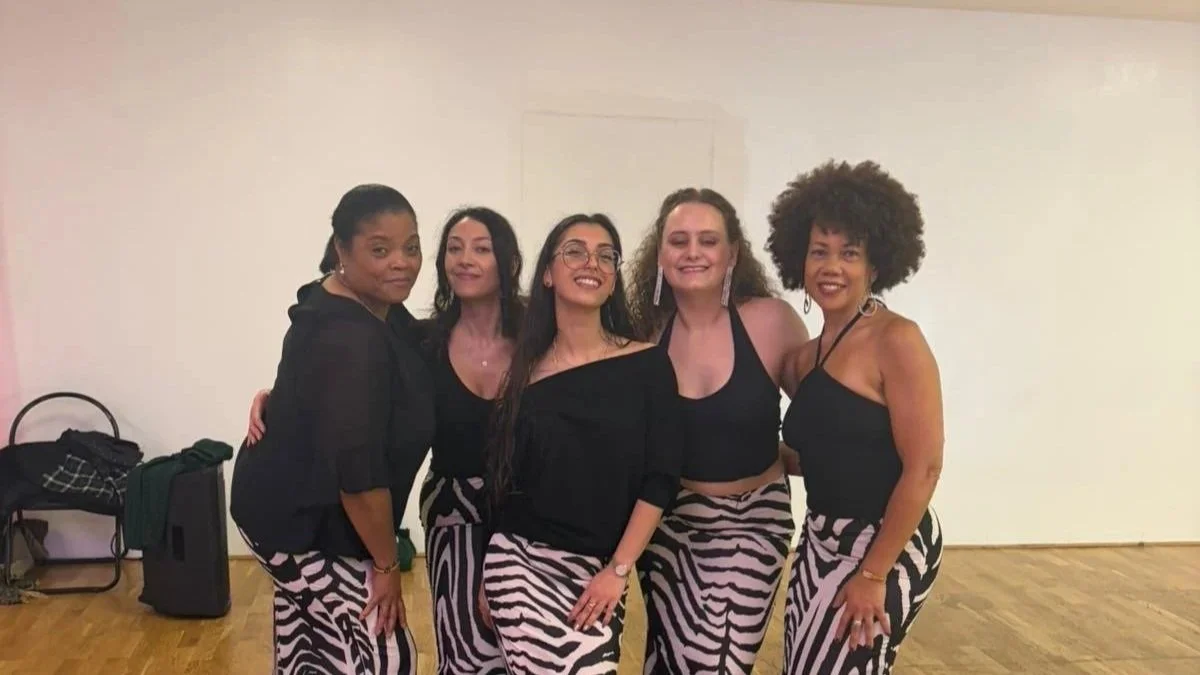
This is the same for me when I dance in a group. Doing a learnt choreography, when we first come together as a group, we are all self conscious, some learn faster than others, and our teacher is very good at creating a fun space for experimentation, trial and error, positive feedback and stretch.
When it all finally comes together is when each of us dancers, are aware of each other in terms of space and supportive energy, we are expressing the steps in our own unique way without comparison but building on each other and we are having fun. The afterglow afterwards as we watch ourselves on video is a feeling that I love and am proud of.
Why this matters for organisations
It would be easy to file all this under “nice, but soft.” I would argue the opposite. In a world of constant change — where many of the leaders I work with are holding uncertainty, restructures and relentless pressure — the ability to create flow is one of the most practical, hard edged skills a leader can have. It is the difference between a team that grinds through its work exhausted and a team that produces its best thinking and actually enjoys the doing of it. Engagement, innovation, retention, wellbeing: these are not separate initiatives. They are what flow looks like when it becomes a habit.
The real work, then, is translation — turning a beautiful idea into tangible benefit. That means asking practical questions of ourselves as leaders. Where in my week do I actually experience flow, and what are its conditions? Can I recreate even one of those conditions for my team this week — more focus, more safety, more momentum? And am I arriving as a flow anchor, present and settled, or as one more source of distraction in an already distracted room?
I do not have this fully worked out. But I have come to believe that the leaders who thrive in the coming years will not be the ones who simply do the most. They will be the ones who know how to create the conditions in which people — themselves included — can be at their best.
I would love to hear where you find flow, at work or beyond it, and what conditions make it possible for you. Or if you would like to explore how to bring more of it into your team, let’s have a conversation.